 FRAMEWORK
v1.2
Open for comment
CC BY 4.0
Updated 2026

Four Faces of AI Risk™
“AI risk” is four kinds of risk, with different causes, owners, controls, and losses. The differences matter.
No one acts against us


Someone acts deliberately


What it is
A way to sort any AI risk by its cause, before you try to measure it. Ask five executives what worries them about AI and you hear four kinds of concern mixed together. Each needs a different owner, different controls, and different data. Treating them as a single risk obscures those differences, leaving executives with a description of what might go wrong but little clarity on what to do about it.
Finance already understands this distinction. Nobody asks for one number called “the risk of the manufacturing line.” Every major asset gets four separate conversations: the investment, errors, misappropriation, and external threats. AI is one more asset that needs all four.
The thinking behind it: A practical way to sort AI risk before you measure it →
Get it
- Overview: what it is and how it worksPDF
- Usage guide, for people and AI assistantsMD
- Presentation deckPPTX
- Model graphicsPNG
- Overlay on the AI Risk MapPNG
- Structured data, for toolsJSON
Built for measurement
Four Faces does two jobs. For executives, it is a mental model: four separate conversations in place of one blended worry about “AI risk.” For risk analysts, it is the first scoping decision in a scenario they can measure. The lines between the faces were drawn for the second job as much as the first.
The face sets the cause, and the cause sets what you estimate from. Scenarios in different faces draw their frequency from different evidence and land different kinds of loss, so each can be estimated, and challenged, on its own terms.
The face names the kind of cause; the scenario names the specific one. One face can hold several scenarios with different threat communities and safeguards: prompt injection, model extraction, and data poisoning are all face 3, and each is scoped and estimated as its own scenario.
Why the lines fall where they do. The 1/2 line separates decisions from operations, because face 1 is measured as variance against a plan, at the pace of decision cycles. The 2/3 line follows intent, because accidents and deliberate misuse come from different threat communities with different frequencies. The 3/4 line follows whose AI, because the safeguards that matter and the evidence for frequency both change when the AI doing the damage is theirs.
The four faces
Each face is a category of risk, not a single risk: the risks you assess are the scenarios inside it. Three are about our own AI: get it right. One is about theirs: be ready.

1 · Strategy · We bet wrong.
Innovate with AI
Are we making the right bets?
We move too slowly, too timidly, or fast with no strategy behind the bets. The AI may work exactly as intended; the choices about where, how fast, and how much were wrong.
- Losing ground to faster competitors
- Bets mistimed or driven by hype
- Returns that never arrive
- Scarce talent and skills
- Cost and dependence that creep up
Value: stranded spend, forgone value, competitive erosion, structural cost increases.

2 · Execution · We botched it.
Build and run AI responsibly
Is it well built and well run?
AI we chose to adopt is badly designed, built, or used. No one acted against us; the cause is ours.
- Wrong or inconsistent answers
- Bias and unequal performance
- Data used without rights or consent
- Obligations missed
- Oversight that cannot keep up
The loss: our AI fails or misfires and harms us or the people who depend on it.

3 · Subversion · They hijacked ours.
Prevent abuse of our AI
Can it be turned against us?
Someone deliberately pushes our AI past the bounds we set, and we did not prevent it.
- Inputs that hijack behavior
- Poisoned data, models, or memory
- Models and secrets extracted
- Compromised supply chain
- Agents turned against us
- Our data or insights carried into someone else's AI
The loss: the outcomes of face 2 or face 4, reached through our own AI.

4 · Attack · They attacked with theirs.
Defend against their AI
Is theirs aimed at us?
Someone turns their AI on us, and we are not ready.
- Deepfake impersonation
- AI-enabled fraud and phishing
- Autonomous attack agents
- Frontier capability with the guardrails stripped
The loss: financial crime, service disruption, data exposure, with the speed, scale, and adaptability only AI makes possible.
Three questions place any AI risk
Faces sort scenarios, not incidents. One incident or register line can hold more than one scenario (edge rules 6 and 8), but each scenario sits in one face. A risk that seems to fit two faces is usually two scenarios.
- Whose AI?
- Theirs, aimed at us → face 4.
- Ours (our AI, or the data, models, and outputs it is built from or produces). Did someone deliberately push it past the bounds we set?
- Yes → face 3.
- No. Where did it go wrong?
- In how AI we chose was built or run, causing an operational failure → face 2.
- Where we chose to invest, how fast, and how much, causing a strategic shortfall → face 1.
This is not a 2×2. Faces 1 and 2 share a cell and are split by a third question: was it the choice of bets, or how a chosen AI was built and run?
One fear, six scenarios
One line on a risk register, “customer data exposed through AI”, holds six scenarios. Each has its own frequency, controls, and data.
- An employee pastes customer records into a public chatbot

- A model memorizes training data and repeats it to the wrong user
- An attacker injects instructions that make our agent hand over data

- A partner loads customer insights from our AI into their own AI and uses them past the terms we set
- An attacker uses AI-written phishing to steal credentials and pull customer data

- We ban AI on customer data out of unfounded fear, while competitors adopt it with sound controls


One register line becomes six scenarios across all four faces.
A companion to the AI Risk Map™
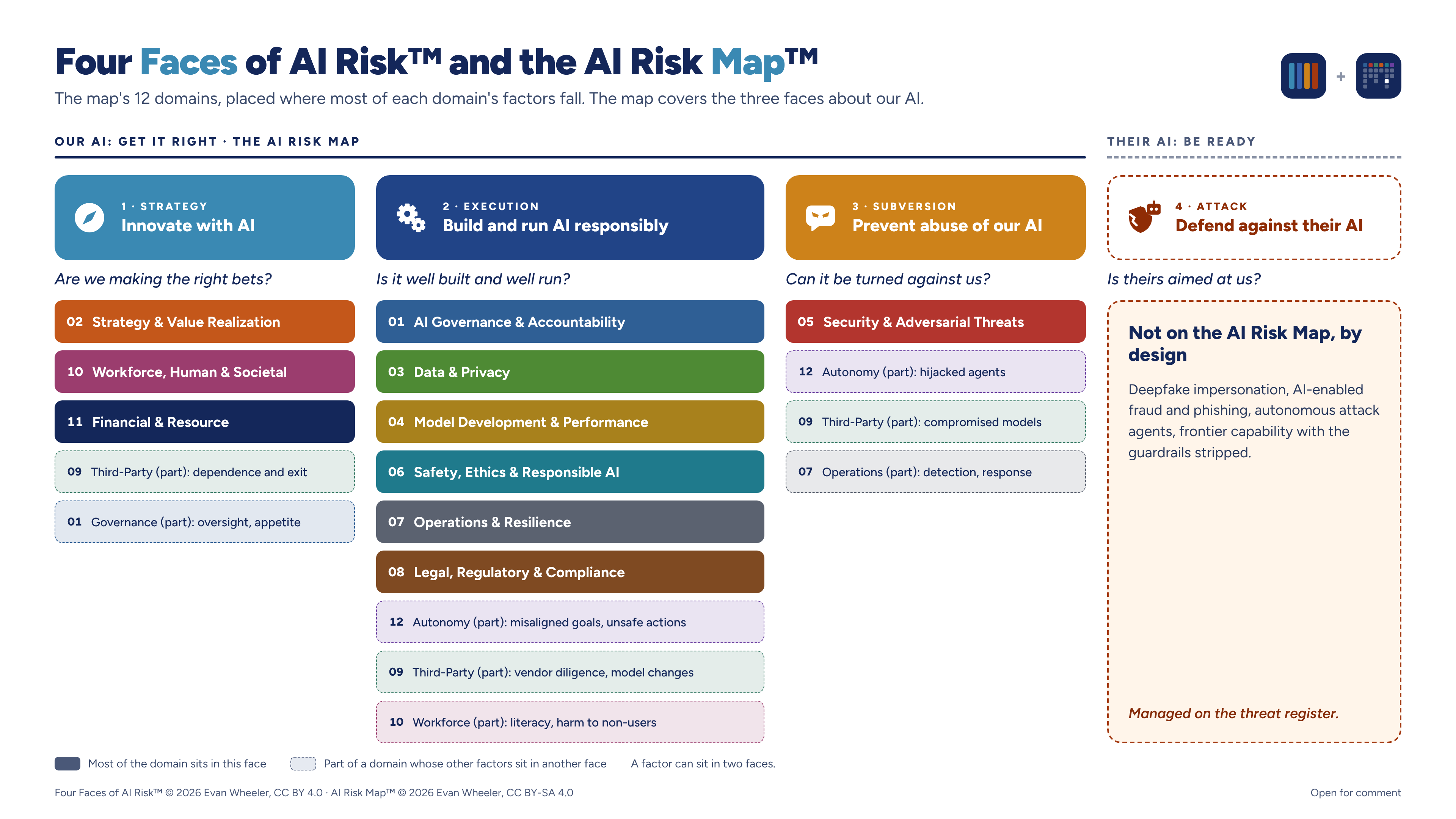
The AI Risk Map lists the risk factors that come with your own use of AI, organized by who owns them. Four Faces sorts the same territory by cause. The AI Risk Map covers faces 1–3. Face 4 is outside its subject boundary by design and belongs on the threat register.
Name the face first, then use the AI Risk Map to widen the scope.
How to use it
- In a workshopSort the fears in the room into faces before anyone starts naming risks.
- Scoping a scenarioAsk the three questions first. The face sets the cause, and the cause drives frequency.
- With executivesLead with the finance view and the shorthand. Use the deck.
What it is not
- Not a catalog or a governance framework. It names four kinds of risk. It does not list risk factors or controls, and it does not tell you how to govern AI.
- Not a measurement method. It helps you define scenarios well enough to measure. How you estimate frequency and loss is the job of your measurement method.
- Not a prioritization. Faces are sorted into, not ranked. Four Faces alone does not tell you which risks to address first.
- Not an org chart. Owners vary by organization. Assigning them is the next conversation.
Limitations
- Intent is not always known when you scope. When it isn't, scope more than one face.
- Face 1 is measured differently: as variance against a plan, at the pace of decision cycles.
How it compares
Other AI risk framings each fit their purpose, mostly program design and planning. Four Faces is built for scoping risk scenarios, and none of the others treats a missed opportunity as a risk.